Global Halal Cosmetics Market Insights, Growth, Share, Size: By Offering, By Gender, By Distribution Channel, By Region & Segmental Forecast, 2023-2031, Comparative Analysis and Trends
- Industry: Consumer Goods
- Report ID: TNR-110-1046
- Number of Pages: 420
- Table/Charts : Yes
- December, 2023
- Base Year : 2024
- No. of Companies : 17+
- No. of Countries : 29
- Views : 10088
- Covid Impact Covered: Yes
- War Impact Covered: Yes
- Formats : PDF, Excel, PPT
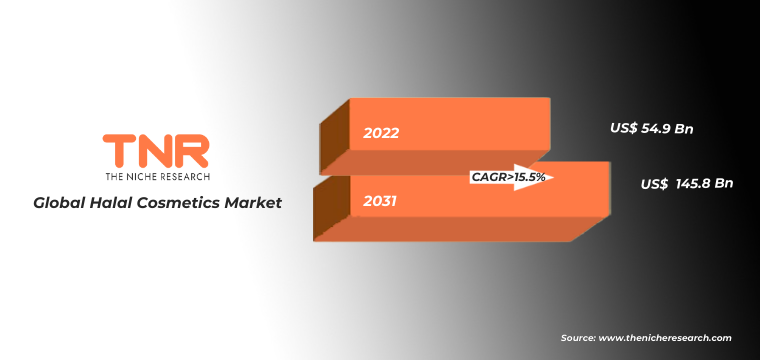
Global Halal Cosmetics Market was Valued at US$ 54.9 Bn in 2022, Growing at an Estimated CAGR of 15.5% During 2023 – 2031.
Halal cosmetics refer to beauty and personal care products that comply with Islamic Shariah law and are free from ingredients prohibited by Islamic principles. They are formulated without ingredients derived from animals that are not slaughtered according to Islamic law (haram), alcohol, and other substances deemed non-permissible in Islam. They’re also free from any cross-contamination during production, ensuring purity and compliance with Halal standards.
The increasing demand for halal cosmetics is primarily attributed to multiple interconnected factors. Firstly, for devout Muslims, the adherence to Halal principles extends beyond dietary choices to encompass various aspects of life, including personal care products. This religious observance significantly drives the demand for halal cosmetics market. Secondly, beyond religious adherence, there’s a growing perception among consumers, both within and outside the Muslim community, that Halal cosmetics offer safer and healthier alternatives due to their strict adherence to ingredient regulations. This is additionally contributing to a broader consumer base seeking products that prioritize safety and cleanliness.
Another factor booting the demand of halal cosmetics market is rise in ethical and environmental consciousness. Consumers are increasingly seeking products that align with their ethical values, including cruelty-free, environmentally friendly, and sustainably sourced options, which Halal cosmetics often encompass. Lastly, the market accessibility of Halal-certified cosmetics has expanded, making them more readily available and appealing to a wider audience. This accessibility has transcended religious boundaries, attracting non-Muslim consumers who value ethical and natural products, further fueling the demand for halal cosmetics market.
The convergence of religious adherence, health considerations, ethical values, and market accessibility has spurred the exponential growth of the halal cosmetics market. This evolution has pushed cosmetic brands to innovate, formulate, and certify products that meet Halal standards while appealing to a diverse consumer base. As a result, the halal cosmetics market continues to grow, diversify, and gain prominence, representing not only a religious preference but also a broader consumer trend towards ethical, clean, and inclusive beauty choices.
Global Halal Cosmetics Market Revenue & Forecast, (US$ Million), 2015 – 2031
The demand for halal cosmetics market showcases intriguing differences between men and women, reflecting distinct preferences and motivations shaped by societal norms and personal inclinations. Women traditionally constitute the primary consumer base for cosmetics, including Halal beauty products. Their interest in skincare, makeup, and hair care has historically been significant, driving the industry forward. For many women, the preference for Halal cosmetics stems from religious observance, as adhering to Islamic principles often involves using products free from ingredients deemed non-permissible. The extensive variety and range of beauty products used by women contribute significantly to the demand for Halal-certified options across diverse categories. Cultural influences and societal norms also play a role, as grooming and personal care often hold higher significance for women in many cultures, further bolstering their interest in Halal cosmetics.
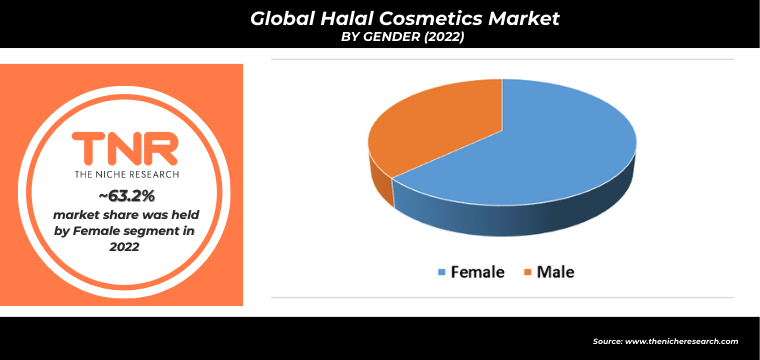
On the other hand, men’s engagement with cosmetics, including Halal products, has traditionally been more limited. However, changing perceptions of masculinity and grooming have led to an increasing interest among men in products that align with their values, including Halal-certified options. While men’s grooming needs might be more specific and focused compared to women, their demand for Halal cosmetics is steadily rising. Factors such as a growing focus on grooming routines, the emergence of Halal-certified men’s grooming products, and the desire for ethical and religiously compliant items have contributed to this evolving trend. Like women, men following Islamic principles prioritize Halal-certified products for religious reasons, contributing to the expansion of halal cosmetics market offerings for men’s grooming category.
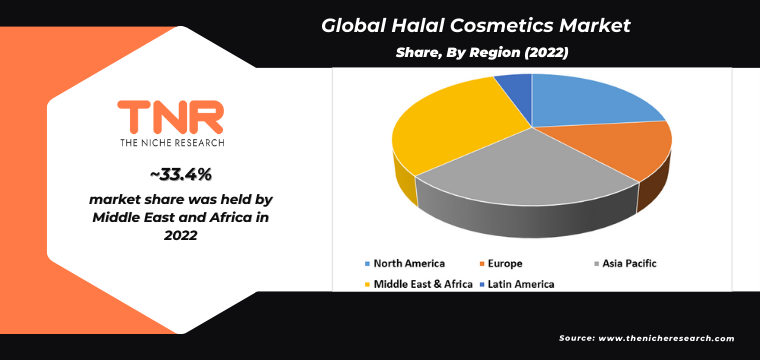
The dominance of the LAMEA (Latin America, Middle East, and Africa) region in the halal cosmetics market is a result of several key factors. Firstly, the region hosts a substantial Muslim population, particularly in the Middle East and parts of Africa. This demographic preference for Halal-certified products due to religious adherence significantly drives the demand for such cosmetics in these areas, establishing a strong consumer base for Halal beauty items.
Cultural and religious influences play a pivotal role in shaping consumer preferences in the LAMEA region. Islamic principles emphasizing Halal standards and modesty greatly impact consumer choices regarding personal care and grooming. This cultural significance is further amplifying the demand for halal cosmetics market, making them a dominant force in the beauty market across the region. Moreover, the beauty industry in LAMEA is witnessing significant growth. Economic development and urbanization have led to increased disposable incomes among consumers. Consequently, there’s a rising trend of spending on personal care products, including Halal cosmetics. This economic growth and evolving consumer habits contribute to the market dominance of Halal beauty items in the region.
Furthermore, companies operating in the LAMEA region have shown a proactive approach in innovating and adapting their product lines to meet the demands of the Halal cosmetics market. This commitment to product innovation and market adaptation has strengthened the availability and diversity of Halal-certified beauty products, further solidifying the region’s dominance in the global halal cosmetics market.
Competitive Landscape
Few of the key competitors operating in the global halal cosmetics market are mentioned below:
- 786 Cosmetics
- Amara Halal Cosmetics
- Breena Beauty
- CLARA INTERNATIONAL BEAUTY GROUP
- ClaraLine
- CLAUDIA NOUR COSMETICS
- Flora & Noor
- HALAL BEAUTY COSMETICS
- Iba
- INGLOT
- Inika Organic
- Islamic Shop
- MERSI COSMETICS
- NUMBER THREE Inc.
- PHB Ethical Beauty
- Saba Personal Care
- Wardah
- ZAHARA
- Other Industry Participants
Global Halal Cosmetics Market
By Offering
- Makeup
-
- Foundation
- Makeup Remover
- BB Cream
- Highlighter
- Skin Tint
- Concealer
- Mascara
- Eye Shadows
- Eye Liner
- Nail Colour & Remover
- Lip Gloss
- Lipstick
- Others
- Skin Care
-
- Face Cream
- Face Wash & Cleanser
- Hand Wash & Sanitizer
- Moisturiser & Gels
- Lip Balm
- Scrubs & Masks
- Facial Oils & Serum
- Toners
- Eye Cream
- Body Wash & Cream
- Beard Oil & Balm
- Beard Serum
- Others
- Hair Care
-
- Shampoo & Conditioner
- Hair Mist
- Hair Oils
- Others
- Fragrance
- Gift Sets & Collections
- Others
By Gender
- Male
- Female
By Distribution Channel
- Online
-
- Manufacturers Website
- E-commerce and Beauty Platforms
- Offline
-
- Retail Stores
- Specialty Stores
- Others
By Region
- North America (U.S., Canada, Mexico, Rest of North America)
- Europe (France, The UK, Spain, Germany, Italy, Nordic Countries (Denmark, Finland, Iceland, Sweden, Norway), Benelux Union (Belgium, The Netherlands, Luxembourg), Rest of Europe)
- Asia Pacific (China, Japan, India, New Zealand, Australia, South Korea, Southeast Asia (Indonesia, Thailand, Malaysia, Singapore, Rest of Southeast Asia), Rest of Asia Pacific)
- Middle East & Africa (Saudi Arabia, UAE, Egypt, Kuwait, South Africa, Rest of Middle East & Africa)
- Latin America (Brazil, Argentina, Rest of Latin America)
Global Halal Cosmetics Market
| Report Specifications | Details |
| Market Revenue in 2022 | US$ 54.9 Bn |
| Market Size Forecast by 2031 | US$ 145.8 Bn |
| Growth Rate (CAGR) | 15.5% |
| Historic Data | 2015 – 2021 |
| Base Year for Estimation | 2022 |
| Forecast Period | 2023 – 2031 |
| Report Inclusions | Market Size & Estimates, Market Dynamics, Competitive Scenario, Trends, Growth Factors, Market Determinants, Key Investment Segmentation, Product/Service/Solutions Benchmarking |
| Segments Covered | By Offering, By Gender, By Distribution Channel |
| Regions Covered | North America, Europe, Asia Pacific, Middle East & Africa, Latin America |
| Countries Covered | U.S., Canada, Mexico, Rest of North America, France, The UK, Spain, Germany, Italy, Nordic Countries (Denmark, Finland, Iceland, Sweden, Norway), Benelux Union (Belgium, The Netherlands, Luxembourg), Rest of Europe, China, Japan, India, New Zealand, Australia, South Korea, Southeast Asia (Indonesia, Thailand, Malaysia, Singapore, Rest of Southeast Asia), Rest of Asia Pacific, Saudi Arabia, UAE, Egypt, Kuwait, South Africa, Rest of Middle East & Africa, Brazil, Argentina, Rest of Latin America |
| Key Players | 786 Cosmetics, Amara Halal Cosmetics, Reena Beauty, CLARA INTERNATIONAL BEAUTY GROUP, ClaraLine, CLAUDIA NOUR COSMETICS, Flora & Noor, HALAL BEAUTY COSMETICS, Iba, INGLOT, Inika Organic, Islamic Shop, MERSI COSMETICS, NUMBER THREE Inc., PHB Ethical Beauty, Saba Personal Care ,Wardah, ZAHARA, Other Industry Participants |
| Customization Scope | Customization allows for the inclusion/modification of content pertaining to geographical regions, countries, and specific market segments. |
| Pricing & Procurement Options | Explore purchase options tailored to your specific research requirements |
| Contact Details | Consult With Our Expert
Japan (Toll-Free): – +81 663-386-8111 South Korea (Toll-Free): – +82-808- 703-126 Saudi Arabia (Toll-Free): – +966 800 850 1643 United States: +1 302-232-5106 United Kingdom: +447537105080 E-mail: [email protected]
|
Report Coverage and Deliverables:
Table of Contents