
Global Ultrapure Water Market Insights, Growth, Share, Size: By Stages, By Delivery Mode, By Technology, By Applications, By End User Industry, By Region & Segmental Forecast, 2023-2031, Comparative Analysis and Trends
- Industry: Chemicals & Materials
- Report ID: TNR-110-1039
- Number of Pages: 420
- Table/Charts : Yes
- December, 2023
- Base Year : 2024
- No. of Companies : 12+
- No. of Countries : 29
- Views : 10095
- Covid Impact Covered: Yes
- War Impact Covered: Yes
- Formats : PDF, Excel, PPT
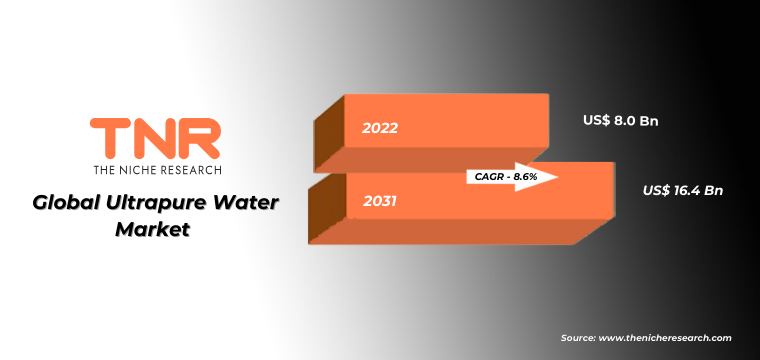
Global Ultrapure Water Market was Valued at US$ 8.0 Bn in 2022, With an Estimated CAGR of 8.6% During 2023 – 2031
The global ultrapure water market is a segment within the larger water treatment industry that specializes in producing high-purity water, typically used in industries such as semiconductors, pharmaceuticals, power generation, and laboratories. Ultrapure water undergoes rigorous filtration processes to remove impurities, minerals, and contaminants, achieving an exceptionally high level of purity, often reaching parts per trillion (ppt) or parts per billion (ppb) levels of impurity. The demand for ultrapure water market has surged due to the growing requirements for precise and contaminant-free water in various industries.
Ultrapure water, an essential component in various industries, is undergoing a transformative phase shaped by several key trends. Sustainability emerges as a paramount concern, driving the integration of green technologies and promoting water reuse and recycling initiatives. Smart water treatment, infused with IoT and AI, is revolutionizing systems, enabling remote monitoring, predictive maintenance, and real-time optimization. Customization takes precedence, with modular systems offering adaptable solutions tailored to distinct industry demands, fostering flexibility and efficiency. Technological advancements in filtration, ion exchange, and pathogen removal underscore the quest for higher purity levels and enhanced contaminant eradication. Remote access, automation, and Industry 4.0 integration revolutionize operations, ensuring seamless functionality and proactive maintenance. Moreover, a profound emphasis on health and safety fuels innovations that target endotoxin control and pathogen removal, particularly critical in pharmaceutical and healthcare sectors. These trends collectively drive the evolution of ultrapure water technologies, fostering sustainability, efficiency, and adaptability to diverse industrial requirements.
Global Ultrapure Water Market Revenue & Forecast, (US$ Million), 2015 – 2031
Delivery Mode Outlook: Global Ultrapure Water Market
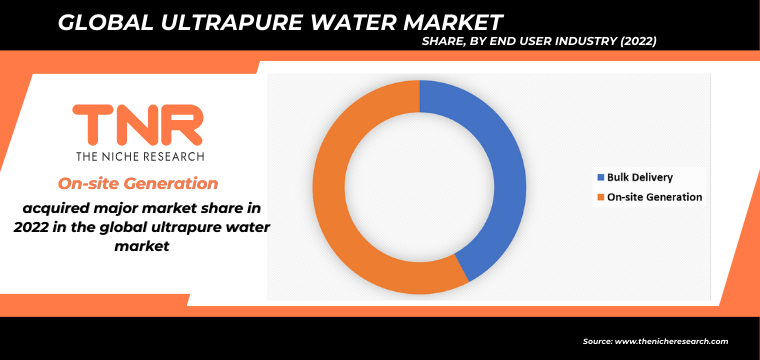
There are primarily two modes of delivery in the global ultrapure water market: bulk delivery and on-site generation:
Bulk Delivery
- Tanker Trucks or Containers: Purified water is transported in bulk via tanker trucks or containers from a central purification facility or a water treatment plant to the end-users’ location.
- Delivery in Large Quantities: Bulk delivery involves supplying significant quantities of ultrapure water to industries or facilities that require high volumes of purified water but might not have the infrastructure for on-site generation.
- Suitable for Remote or Specialized Needs: It’s beneficial for remote areas or industries were setting up on-site generation might not be feasible due to logistical challenges or specific operational requirements.
On-site Generation
In this mode, ultrapure water is generated on-site at the end-user’s facility using purification systems or water treatment equipment installed on their premises. On-site generation ensures a continuous supply of ultrapure water without dependence on external suppliers, offering flexibility and control over the water quality. On-site systems can be customized to meet the specific purity requirements of the industry or application, providing tailored solutions.
Technology Outlook: Global Ultrapure Water Market
Reverse Osmosis (RO) technology is a pivotal method within the ultrapure water market due to its effectiveness in purifying water. In RO, pressure is applied to a solution (water) to pass through a semipermeable membrane, separating solute (impurities, minerals, contaminants) from the solvent (water molecules). This process is crucial in achieving high-purity water suitable for various industries. For example, in semiconductor manufacturing, ultrapure water is a critical component in the production of silicon chips. Even trace impurities in water can affect chip quality. RO systems are extensively used in this industry to produce ultrapure water with extremely low levels of impurities, often reaching parts per billion (ppb) or even parts per trillion (ppt) levels. The stringent purity requirements demand advanced purification techniques, and RO technology plays a fundamental role in meeting these standards. In semiconductor fabrication facilities (fabs), RO systems are integrated into the water treatment process to ensure the water used in various chip manufacturing stages is of ultrahigh purity. These systems remove contaminants, dissolved solids, and particles, delivering water that meets the precise specifications essential for semiconductor production.
The use of RO technology in the semiconductor industry is just one example showcasing its significance in providing ultrapure water. Its application extends to pharmaceutical manufacturing, laboratories, power generation, and other sectors where water of exceptional purity is a necessity. The reliability, efficiency, and high purification capability of RO systems make them a cornerstone of the ultrapure water market.
 Global Ultrapure Water Market: Regional Analysis:
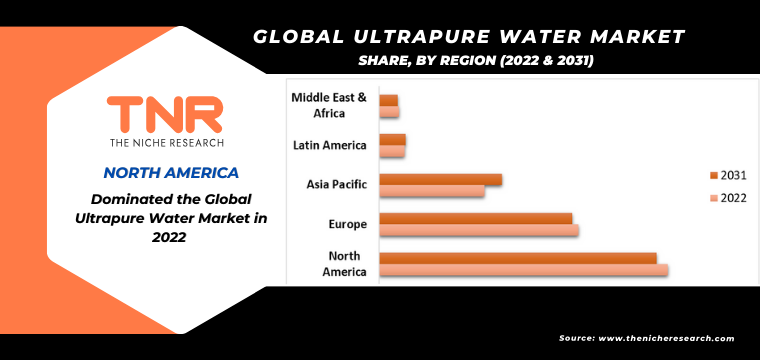
In North America, the ultrapure water market is undergoing a significant transformation driven by a convergence of technological innovation, regulatory demands, and a shift towards sustainability. The region’s robust industrial landscape, particularly in semiconductor manufacturing and pharmaceuticals, fuels the demand for ultrapure water of the highest quality. This demand serves as a catalyst for continuous technological advancements in purification processes and systems.
Stricter regulatory standards across various sectors, including healthcare and electronics, are pushing the need for ultrapure water that adheres to precise purity criteria. This stringent compliance, combined with the region’s commitment to sustainability, is fostering a movement towards eco-friendly water treatment solutions. Companies are investing heavily in green technologies and exploring water reuse strategies to reduce environmental impact and align with evolving regulations.
The ultrapure water market in North America is characterized by a trend towards tailored solutions catering to specific industry needs. Customization is becoming increasingly vital, allowing for modular systems that can adapt to the unique purity requirements of diverse sectors, from semiconductor fabrication to pharmaceutical research laboratories. Integration of smart technologies like IoT, AI, and data analytics is revolutionizing water treatment systems. This shift towards smart water treatment enables remote monitoring, predictive maintenance, and real-time optimization, ensuring efficiency and minimizing downtime across various industrial applications.
Amidst intense market competition, companies vie to offer superior purification systems, cutting-edge technologies, and top-notch services. This competitive landscape fosters an environment of innovation and drives the continuous evolution of ultrapure water market in North America. As a result, the industry is positioned to meet the stringent demands of various sectors while pushing the boundaries of water purification technology, sustainability, and regulatory compliance.
Competitive Landscape: Global Ultrapure Water Market
The competitive landscape of the global ultrapure water market is characterized by the presence of several key players vying for market share through innovation, diverse product offerings, and strategic expansions. A few of the key players in the global ultrapure water market are listed below:
- Asahi Kasei
- Danaher Corporation
- DuPont
- Ecolab
- Evoqua Water Technologies
- Hydranautics
- Kurita Water Industries
- MANN+HUMMEL
- Organo Corporation
- Ovivo Inc.
- Pentair
- Thermo Fisher Scientific Inc.
- Veolia
- Other Market Participants
Global Ultrapure Water Market Summary
| Report Specifications | Details |
| Market Revenue in 2022 | US$ 8.0 Bn |
| Market Size Forecast by 2031 | US$ 16.4 Bn |
| Growth Rate (CAGR) | 8.6% |
| Historic Data | 2015 – 2021 |
| Base Year for Estimation | 2022 |
| Forecast Period | 2023 – 2031 |
| Report Inclusions | Market Size & Estimates, Market Dynamics, Competitive Scenario, Trends, Growth Factors, Market Determinants, Key Investment Segmentation, Product/Service/Solutions Benchmarking |
| Segments Covered | By Stages, By Delivery Mode, By Technology, By Applications, By End User Industry |
| Regions Covered | North America, Europe, Asia Pacific, Middle East & Africa, Latin America |
| Countries Covered | U.S., Canada, Mexico, Rest of North America, France, The UK, Spain, Germany, Italy, Nordic Countries (Denmark, Finland, Iceland, Sweden, Norway), Benelux Union (Belgium, The Netherlands, Luxembourg), Rest of Europe, China, Japan, India, New Zealand, Australia, South Korea, Southeast Asia (Indonesia, Thailand, Malaysia, Singapore, Rest of Southeast Asia), Rest of Asia Pacific, Saudi Arabia, UAE, Egypt, Kuwait, South Africa, Rest of Middle East & Africa, Brazil, Argentina, Rest of Latin America |
| Key Players | Asahi Kasei, Danaher Corporation, DuPont, Ecolab, Evoqua Water Technologies, Hydranautics, Kurita Water Industries, MANN+HUMMEL, Organo Corporation, Ovivo Inc., Pentair, Thermo Fisher Scientific Inc., Veolia, Other Market Participants |
| Customization Scope | Customization allows for the inclusion/modification of content pertaining to geographical regions, countries, and specific market segments. |
| Pricing & Procurement Options | Explore purchase options tailored to your specific research requirements |
| Contact Details | Consult With Our Expert
Japan (Toll-Free): +81 663-386-8111 South Korea (Toll-Free): +82-808- 703-126 Saudi Arabia (Toll-Free): +966 800-850-1643 United Kingdom: +44 753-710-5080 United States: +1 302-232-5106 E-mail: [email protected]
|
Global Ultrapure Water Market Scope
By Stages
- Pretreatment
- Primary
- Polishing
By Delivery Mode
- Bulk Delivery
- On-site Generation
By Technology
- Reverse Osmosis (RO)
- Continuous electrodeionisation
- Degasification
- Deionisation
- Advanced oxidation
- Ultrafiltration (UF)
- Microfiltration (MF)
By Applications
- High Performance Liquid Chromatography (HPLC)
- Liquid Chromatography – Mass Spectrometry (LC-MS)
- Gas Chromatography – Mass Spectrometry (GC-MS)
- Graphite Furnace Atomic Absorption Spectroscopy (GFAAS)
- Polymerase chain reaction (PCR)
- Immunochemistry (ICC)
- Mammalian cell culture
- Clinical analysers
- Trace Analysis
- Others
By End User Industry
- Pharmaceutical & Biotechnology
- Semiconductor Manufacturing & Electronics
- Power
- Chemical
- Food & Beverage
- Oil & Gas
- Aquatic Facilities / Water Recreational Industry
- Others
By Region
- North America (U.S., Canada, Mexico, Rest of North America)
- Europe (France, The UK, Spain, Germany, Italy, Nordic Countries (Denmark, Finland, Iceland, Sweden, Norway), Benelux Union (Belgium, The Netherlands, Luxembourg), Rest of Europe)
- Asia Pacific (China, Japan, India, New Zealand, Australia, South Korea, Southeast Asia (Indonesia, Thailand, Malaysia, Singapore, Rest of Southeast Asia), Rest of Asia Pacific)
- Middle East & Africa (Saudi Arabia, UAE, Egypt, Kuwait, South Africa, Rest of Middle East & Africa)
- Latin America (Brazil, Argentina, Rest of Latin America)
Report Snapshot
Table of Contents